Frequencies in Use
Frequencies in Use
Voice and SSTV Downlink: 145.80 (Worldwide)
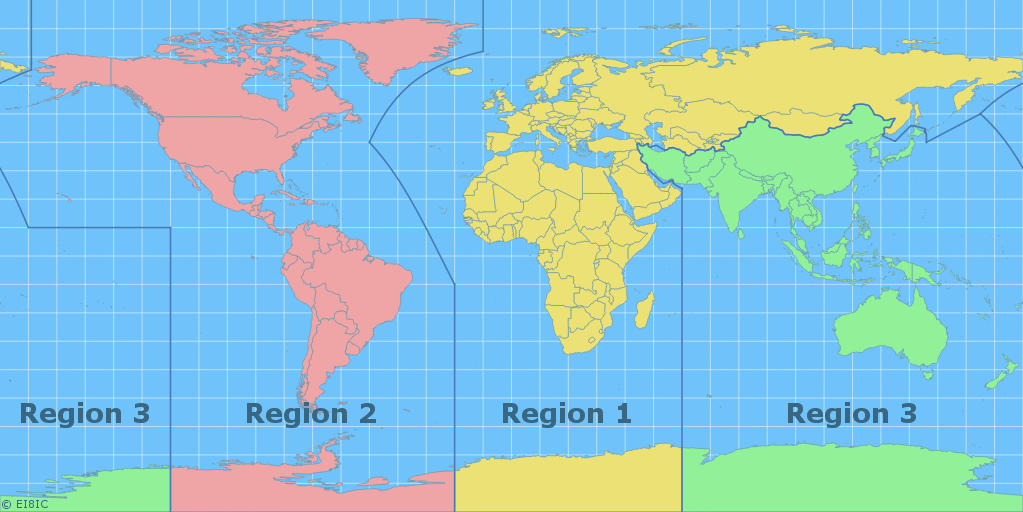
Voice Uplink: 144.49 for ITU Regions 2 and 3 (The Americas, and the Pacific and Southern Asia)
Voice Uplink: 145.20 for ITU Region 1 (Europe, Russia and Africa)
VHF Packet Uplink and Downlink: 145.825 (Worldwide)
UHF Packet Uplink and Downlink: 437.550
VHF/UHF Repeater Uplink: 145.99 (PL 67 Hz)
VHF/UHF Repeater Downlink: 437.80
For a description of ITU regions, consult the ITU map.
Most ARISS operations are split-frequency (each station uses separate receive and transmit frequencies). The downlink is the earth station’s receiving frequency. The uplink is the earth station’s transmitting frequency. Earth stations can listen to the downlink frequency and transmit on the uplink frequency when the ISS is in range and crew members are on the air. Please do not transmit on the ISS downlink frequency.
The Kenwood TM-D710E radio is located in the ISS Service Module (Zvezda), supports 2 meter (144-146 MHz) and 70 cm (435-438 MHz) operation. This radio provides a higher output power capability supporting FM and SSTV operations. The higher power capability allows nearly horizon-to-horizon signal reception using simple hand-held radios or scanners. A set of 5 default options, or Programmable Memories, are embedded in the D710E to support ISS operations.
There are numerous channels programmed in the radios. Two of these channels on the 2 meter radio band support voice operations (145.80 down/144.49 up for ITU Regions 2 &3 & 145.80 down/145.20 up for ITU Region 1). It is necessary to use two uplink frequencies to operate in accordance with region-to-region IARU band plan differences.
The crew switches between one frequency to the other; scanning is not used. For example, if a crew member begins a QSO over the US, they can track US stations until they hit the Atlantic and then they will quickly lose US stations. They can then switch over to the other frequency and pick up stations in Europe or Africa.
A Kenwood D710 radio located in the Service Module was deployed by the Russian Space Agency, Energia to provide extended support of imaging experiments using various SSTV formats. It employs SpaceCam and MMSSTV software to transmit stored images.
See the European Space Agency’s video, How to get pictures from the International Space Station via amateur radio
In preparation for future ISS SSTV events, a video demonstration of receiving SSTV from the ISS was created by avid ARISS supporter, John Brier, KG4AKV. In addition, John has provided an excellent online tutorial explaining in more detail how to configure a simple system to acquire and view the SSTV images. Links to both can be found at https://www.youtube.com/watch?v=7to9uX1sWC4 and https://spacecomms.wordpress.com/iss-sstv-reception-hints/.
To view or submit SSTV received images transmitted from the ISS, and to follow SSTV operations, check out the ISS SSTV blog site.