Contact the ISS
Some ISS crew members make random, unscheduled, amateur radio voice contacts with earth-bound radio amateurs, often called “hams”.
They can make radio contacts during their breaks, pre-sleep time and before and after mealtime. Astronauts have contacted thousands of hams around the world. The work schedules of the ISS crew dictate when they are able to operate the radios. The crew’s usual waking period is 0730 – 1930 UTC. The most common times to find a crew member making casual periods are about one hour after waking and before sleeping, when they have personal time. They’re usually free most of the weekend, as well.
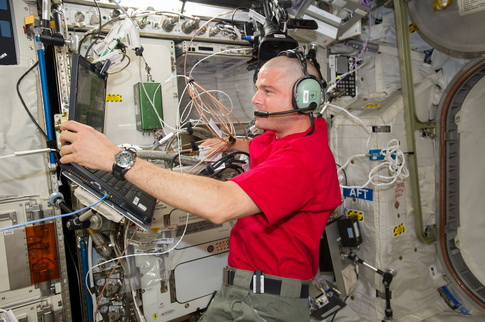
Astronaut Reid Wiseman, KF5LKT makes personal contacts with hams during the US Field Day exercise in June 2014.
The crew can operate the Kenwood radio in the crossband repeater mode, and hams can make contacts with the ISS station when the crew members are working. Hams can also communicate with each other using the ISS packet (computer) radio mode, or receive slow scan television mode images. It all depends on what equipment is in service in space.
Orbit Prediction Software
Commercial and public domain software is available to help track when the ISS will be in range of your station, and where to point your antenna. Various online programs allow you to follow the path of satellites, including the ISS.
You’ll find one such pass prediction tool on the AMSAT website. Use the drop-down menu to select the “ISS” as the satellite you want to track and enter your longitude and latitude information. Click on the link provided on that page to view the current location of the ISS. You’ll find this and other tools for satellite tracking on the AMSAT website at www.amsat.org/amsat-new/tools/.
Radios, Modes and Antennas on the ISS
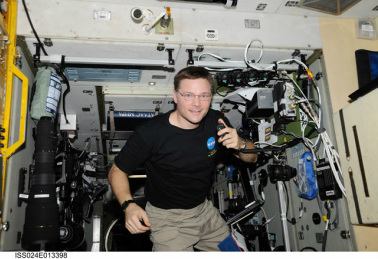
The ISS amateur radios are a Kenwood D710E and a Kenwood D710GA.
The Kenwood TM-D710GA radio is located in the ISS Columbus Module, supports 2 meter (144-146 MHz) and 70 cm (435-438 MHz) operation. This radio provides a higher output power capability (restricted to a maximum of 25 Watts in ISS operation) supporting FM and packet operations. The higher power capability allows nearly horizon-to-horizon signal reception using simple hand-held radios or scanners. A set of 5 default options, or Programmable Memories, are embedded in the D710GA to support ISS operations.
There are numerous channels programmed in the radios. All regions support voice operations on 145.800 MHz down for scheduled activities. They also support the cross-band voice repeater of 437.800 MHz down and 145.990 MHz up (CTSSS 67 Hz). Also, when active, APRS packet radio is on 145.825 MHz worldwide. ARISS may use other frequencies for uplinks and other non-published activities, which are dependent on ITU Regional guidelines.)
The crew switches between one frequency to the other; scanning is not used. For example, if a crew member begins a QSO over the US, they can track US stations until they hit the Atlantic and then they will quickly lose US stations. They can then switch over to the other frequency and pick up stations in Europe or Africa.