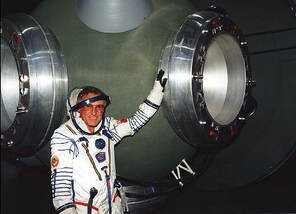
Tony with full-scale Mir replica
January 2026—As part of the ARISS 25th anniversary year-long celebration, we are publishing a series of interviews with founding members and legends in the organization. Our first interviewee is Tony Hutchison, who has been an ARISS pillar since the beginning of the organization in November 1996, and before that, with the SAREX space shuttle program.
Tony “retired” from his volunteer work with ARISS in 2022 but was gracious enough to sit for our interview and to provide many photos, which are included in the story in part as well as in a photo gallery (coming soon). Overall, from 1993 to 2023, Tony was personally responsible for making nearly 200 contacts for Australian and international schools, as well as astronaut requests to talk to family and friends. Along with helping to open the eyes of countless students to the wonders of amateur radio and the possibilities of careers in space, he helped many a lonely astronaut and cosmonaut maintain their mental health by connecting them to friends and family.
PictureFigure 2 Tony and Jill at a park in Renmark
ARISS: Tell us about yourself—where do you live, and where did you grow up?
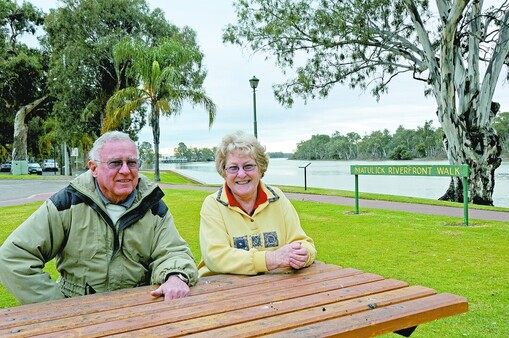
Tony and Jill at a park in Renmark
I live in Kingston with my wife, Jill, and our Staffordshire Terrier, Roxy. There are three Kingstons in Australia—we live in the one in Southeast of South Australia.
I was born in August 1939, about a week before the Second World War started, and I grew up in Bordertown, Australia, where my parents had a farm. That’s about 100 km from where I am now. My dad was a third or fourth generation farmer. It was mixed farming, mainly sheep but also a little bit of seed growing…wheat, oats and barley, which were fairly common in those days. These days, it’s canola and beans and everything else. I spent nearly 50 years on the farm. I loved it, but it wasn’t my first love.
I think my first love, really, was electronics. I can remember when I was about 10 starting on electronic things. Dad never encouraged me but mum fostered my interest. I remember the first project I ever built. Dad had an old windup gramophone with a sound-arm on it and I wanted to build an electronic amplifier. So, I removed the old sound-arm and put on a new one. It had a crystal cartridge, I think, under it. Then I built up a little two valve (vacuum tube) amplifier powered by a 45-volt and a 1.5-volt battery and the amplifier powered a speaker. We all thought it sounded pretty good. I played with that for a long time until one day I was winding it up and there was a great bang and a rustling noise—and yeah, the spring had broken! I also remember building a little five-valve battery-powered radio at about the same age.
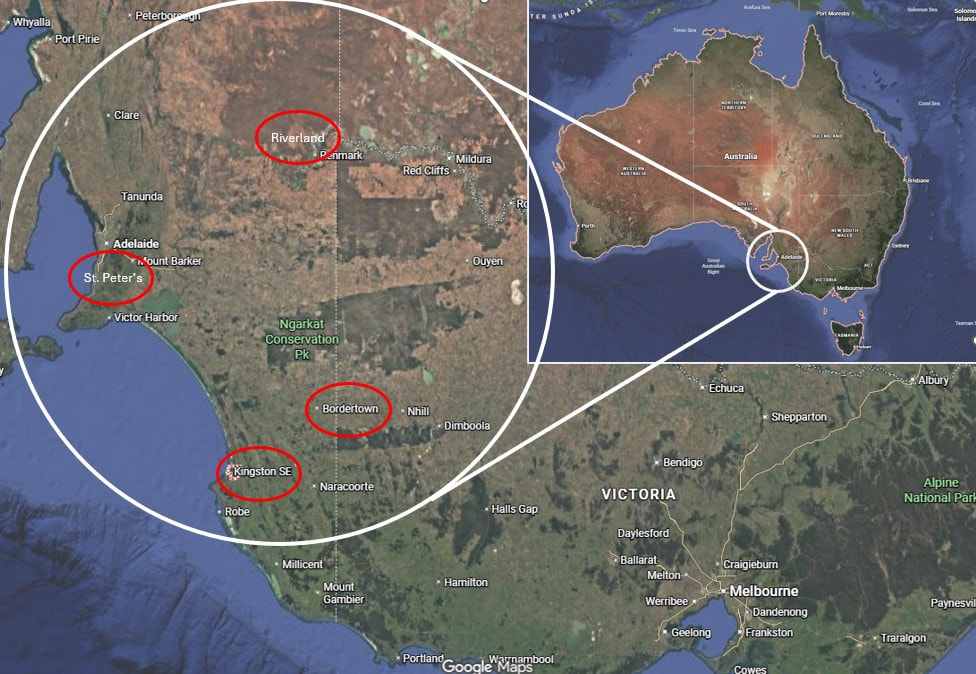
Annotated Google Map showing locations where Tony has lived and attended college
ARISS: Tell us about your education
I went to the Bordertown Primary School to Grade 7. I was a pretty average, actually a very average student. What I didn’t like to learn I didn’t take a lot of interest in, like history and English and I was a very poor reader and writer. But when I finished grade 6, I had a teacher by the name of Rex Rowe. One day he said, “Look, you know jolly well you’re not even trying to read and write. But would you like to get some books on electronics? ”I said, I’d love that.” and he said, “I’ll get some for you…there’s some projects in them and it’s a bit of reading,” but that was the start of my interest in electronics.
For secondary education, I went to St. Peter’s College in Adelaide where I boarded, which ironically, is the same college that (astronaut) Andy Thomas went to, and also Adrian Thomas, his father. So I suppose we had an old school connection. [Tony talks about Andy and Adrian later in the interview]
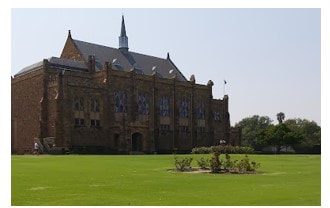
St. Peter’s College
At St Peter’s we were supposed to pick a language to learn. It was expected. And I said I was going to take German, but after the first term, my German teacher said, “I don’t think you’ll ever be able to manage another language”. But we had options: If you weren’t good at language, you had a choice of extra bookkeeping or engineering. Well, I took engineering, it turned out that St. Peter’s had a very good engineering workshop. We did metal work, tool making and casting. We could do anything in that workshop, and I became a bit of a favorite of our engineering master. He gave me a few privileges, like I had the key to the engineering workshop to work on things after hours. I learned that engineering and electronics go together nicely.
My engineering training paid off later in life when I built with my family a beach shack and a 62-foot steel houseboat! The Nooralie, powered by a Perkins 400 horsepower engine, took 14 months to build and we launched her on November 17, 1984. We also did several marine contacts to Mir and the ISS from the Nooralie [Note: Nooralie is the Aboriginal name for the spirit of the Murray River region, a name Tony’s daughter chose].
It was about this time that I got into amateur radio…
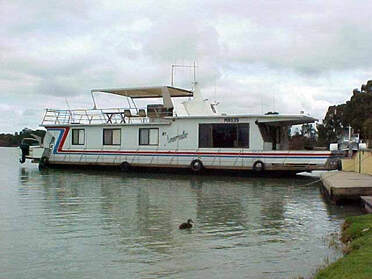
The Nooralie
We had a person that lived up the road. He was a local fire control officer. Harold was also a farmer and he had an old ex-military radio. We had a very big voluntary fire service in those days. One day I saw him throw an aerial up over a tree and start talking to the fire network. And I thought, gee, that’s pretty good. That intrigued me a bit. And then I sort of started reading a bit more about amateur radio. The closest amateur was a guy living about 20-odd miles away, and I went over to see him one time. Another amateur lived over the border in Victoria and he was very active. I’ll say there was very little commercial amateur gear available at that time. Mainly, you had to build your gear yourself.
I started studying to get my ham license. Before I got my license though I built a receiver that would cover from 30 MHz right down to broadcast band in five switchable bands. When I got my license, I didn’t sit for the Morse code, so I had what they call a restricted license, which would only allow me to operate on six meters and upwards.
I built my first receiver and the transmitter. It was all valve gear that would give me 50-60 watts out. Then I bought an excessed military transmitter called an SCR-522. I had an idea they fitted them to B24 Liberators during the war. It was a crank-type radio. It had five bands and three or four circuits you had to tune. They had five different frequencies you’d use, and they’d use a solenoid to push against each capacitor to tune them and then you lock it in place. This was all AM stuff.
Then I managed to get a pair of QB 3-300 valves, they were big glass tubes, and needed, I think, about 1500 volts on the anode. And I built that up running AM, and the pair of them would run 1000 watts. It had a pair of mercury vapor rectifiers that, as you spoke, would modulate beautiful electric blue color. It was strictly illegal. We were only allowed 150 watts. Even now we’re only allowed, I think it’s 400 watts, but you can get a permit for experimenting to run more. At the time, I knew the radio inspector, Rob, very well, and he was a good sort. He said, “Yeah, you live out in the country and you’ve got to run a bit of power to get anywhere.” He said as long as I didn’t create any TV trouble with anyone, he “couldn’t care less.” But he said, if I did generate some interference, I’d probably see him.
Mixed in with all of this, I met Jill in 1961. We did most of our courting in my radio shack. She’d have a book in hand—she loved to read…still does—and I’d have a microphone in my hand, talking to the guys. When we got married in 1963, dad split a section of land off for us; We didn’t have much money so we took out a 10-year loan and built our own brick home on the farm—-and so we worked the two farms together.
ARISS: And is this about the time that you got interested in satellites?
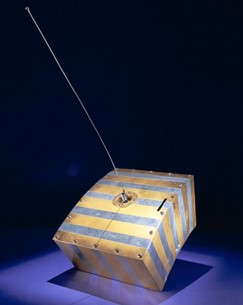
Oscar 1
I got my ham license in 1960 and it wasn’t long after that the amateur radio community launched Oscar 1 (OSCAR 1 – Wikipedia) in December 1961 and Oscar 2 about six months after, and this really whetted my appetite. So I built up a twin helical antenna on a timber stand with an elevation and azimuth pivots.
When Oscar 3 (OSCAR 3 – Wikipedia) was launched in 1965, it would type out “Hi” to you as it flew over, and it also had a repeater on it. The earlier satellites also transmitted “Hi”, but in Morse code. There weren’t many satellites back then. There was a guy working for the local telecom company who would come out from Bordertown, and another ham from over in Victoria, together we would track Oscar 3. We had to calculate where it was, no computers back then to calculate it for us, so we were working with one of the universities in Melbourne who was also tracking it.
We got recognized in the ARRL QST Journal for what we did with Oscar 3 in 1965. Our antenna was outside the end of the house, and at that stage, we hadn’t filled all the bedrooms with kids. My shack was in the new house, and we only had our eldest daughter then. The antenna was outside her bedroom window at the end of the house. So we would leave the window open and I gave Jill a set of headphones and she would just climb up the little tower and hand-direct the antenna.
The antenna was only about five feet off the ground, and she could handle the elevation because it was counterbalanced by two or three bricks on the back end. She would listen and home in on the strongest signal. Jill knew what she was getting into before we got married, She’s been a wonderful help, especially setting up for ARISS contacts at schools. I’ve been so fortunate to have a wife who enjoys my hobby of ham radio. In 2012. Jill was made an Honorary Member of the South East Amateur Radio Group “SERG”, our local ham club in Mt. Gambier, for the catering work she has done for years at our annual conventions.
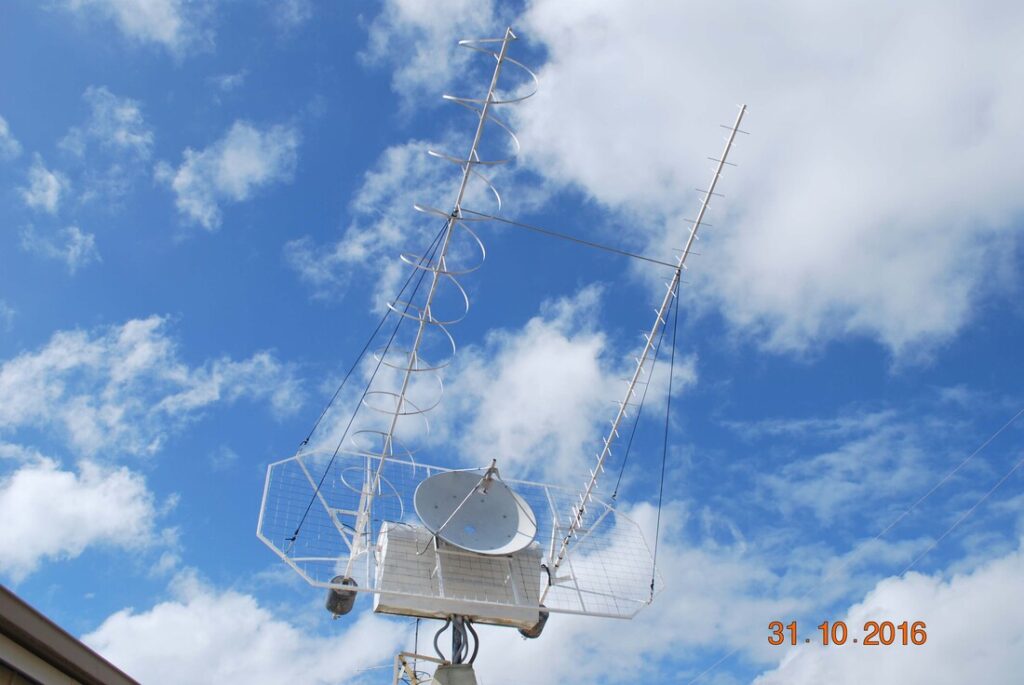
One of Tony’s homemade satellite antennas, circa 2016
ARISS: So how did you start doing commercial electronics work?
Just after we got married in 1963, I was offered a job with the local electrical retailing business to see if I could help out repairing a few TVs. About that time, transistors started to come in and I kept well abreast of the progress they were making. And one by one, the old valve televisions failed and went out, and the transistor ones came in. I worked on TVs and two-way radios for about 15 years.
 One very special opportunity occurred in that time: The guy I worked for had the agency for Philips TV and I was lucky that just before color TV first came out in Australia, I was one of around 10 people selected in Australia to go down to the Phillips factory in Adelaide and work in the lab for 3-4 weeks. They paid for it. They put us up at a motel and we got firsthand experience on color TVs. It was a great honor to have been selected by the company. Philips employed, I think about 4000 people in its heyday down at suburb called Hendon, a suburb of Adelaide they had a very big line going there with transistors, then they later shifted into chips.
I also got involved in community radio in the 1970s. There was a ham guy named Gordon Coad (VK5CC) who lived about 20 miles away, who wanted to set up a community radio station in our hometown of Bordertown. Now, community radio stations here are on the normal FM channels, under the eyes of the Broadcast Australia. And it had to be properly done. They could be sponsored by various companies around but they didn’t call it advertising. Instead, you were allowed to state that, you know, so and so sponsors this program. Anyway, it took us about five years of testing to get our license to have broadcasters. The station was called 5TCB-FM then, and now it’s called Connect FM.
Gordon and I installed a loaned Collins transmitter, for testing purposes but once we received our permanent license, we installed a 1,000 Watt Italian-made transmitter and I believe it’s still going well today. I stayed on as senior technician there for around 12 years, it was a voluntary job. I resigned from the committee after we moved to the Riverland. Later I was presented with a life membership for the work I did—building all the studio consoles and keeping the station on air.
I had taken a break from ham radio when Jill and I were raising our three children. The girls wanted to ride horses at the local pony club and our son Richard joined the scouts, and I got talked into becoming the deputy scout leader. So, yeah that took up a fair bit of time, running a farm and an electrical business as well. It was a busy time—I kept a record of the TV sets and radio jobs I did: In one year, there were 560. I used to do the maintenance on police, ambulance and fire brigade radios.
ARISS: When did you move from Bordertown to Riverland?
We sold the farm in 1988 and we moved up to Riverland (Figure 3), that’s where I got started with amateur radio again. We had a beautiful place of 25 acres and a private river frontage. I built a tower there with two Yagi antennas that I made especially for the satellites. Tracking was computer controlled and fully automated.
ARISS: Tell us about your work with packet data and the Mir space station.
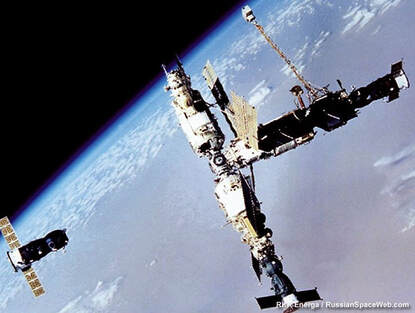
Mir space station
I got into Packet radio with the satellites UO-22, KO-23 and KO_25 and ran the Australian bulletin board for a short time exchanging international mail via satellite and distributing it around Australia.This led directly to my amateur radio work with the bulletin board on the Mir space station sending packet messages to and from the crew and others around the world.
I would also listen to the Mir space station and try to contact the cosmonauts. As it turned out, they were more interested in talking to an American woman from Connecticut named Maggie, who had moved to Melbourne with her husband. She was an avid ham who could speak Russian fluently. A lot of the cosmonauts liked to improve their English, and I heard that’s why they liked having conversations in English with Americans and Australians.
I kept on calling but they were mostly looking for Maggie [Margaret Iaquinto, VK3NQQ] in Melbourne, who they had been talking with since 1990. We knew her as Maggie but the Russians all referred to her as Rita.
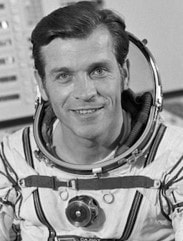
Alex Serebrov
I did have contact with several cosmonauts on Mir, but I didn’t develop a relationship with any of them until Alex [Aleksandr] Serebrov during his second stay on the Mir (July 1, 1993, to January 14, 1994). Alex and I struck up a very good friendship. He was a born-again Christian, and he was very interested in Adelaide because his wife was a ballerina with a Bolshoi Ballet, and she came out two or three times and danced at Adelaide. But Alex, he’d call me probably once or twice a week from Mir as he passed over, Jill would give me a nudge to wake me and say, “Alex is calling you.”
Alex wanted to know what the cost of living was like in Australia. So I wrote out a list and sent it up on packet radio for him. I sent the average price of a house and a car and, and the cost of meat and vegetables and just for the heck of it, I put in the price of a bottle of vodka. He called me the next night and he said the pricing in Australia was not too bad, but, but he said, we’re really being ripped off. “I could get half a dozen bottles of vodka for that price in Russia,” he said.
ARISS: Tell us about your relationship with Australian NASA astronaut, Andy Thomas.
[Note: Andy Thomas was the last of the group of astronauts who flew on the MIR as part of NASA’s preparation for life aboard the International Space Station (ISS). Andy launched on Space Shuttle Endeavor as part of the STS-89 crew in January 1998 and returned from Mir on Space Shuttle Discovery (STS-91) in June 1998.]
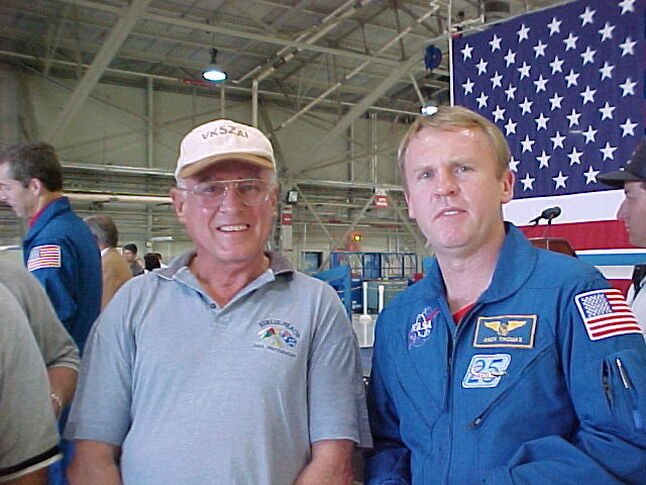
Tony and Andy Thomas
During his 140 days on Mir, we helped Andy to carry out personal contacts with his father, Adrian, using the ham radio system on Mir. Adrian lived in a southern suburb of Adelaide and was a Lancaster pilot during World War 2, one of the few, I think, that actually got back in one piece after flying sorties over Germany. In order to do the contacts, we had to petition the Australian Communications and Media Authority, which controlled all radio and commercial radio in Australia, and ask them if we could lend Adrian a small handheld radio to speak to his son as he passed over.
And the word came back, “No.” So I thought I could call Adrian on the phone and patch him into his son on Mir from my radio, but there was one problem: We didn’t have a third-party agreement with Russia. So I asked my brother-in-law, Trevor, who worked for communications authority in Adelaide, to find out if Adrian could talk to Andy on Mir as a third party.
About a week later, Trevor rang up and said here’s the issue: Andy’s an Australian citizen; he’s got an American license, but Mir is Russian territory. Anyway, the long and short of it was it’s too hard to work out. In the end, they said, “We don’t really want to know about it, but go your hardest, but try not to tell too many people.” Which is funny, because, I mean, every ham in Adelaide was listening out for these contacts!
There was another funny story when Andy was on Mir. One of the Russians onboard wanted to talk to Maggie. At that stage, Maggie’s marriage had fallen apart, and she didn’t have a lot of gain in the antenna she was using in her location. So I rang Maggie and we worked out a schedule to do the contact. When the scheduled contact was due, of course, everyone in Australia was listening in when [the Mir] went over. The cosmonaut started calling “Rita, Rita, do you hear me Rita” a couple of times. At the same time there was another ham in Adelaide who was trying to talk to Mir, and he said, “I don’t know who that guy is being a fool, but would he keep off the air please because we want to speak to one of the astronauts!”
Andy had to come back on the radio, and he said look, I’m sorry, but my commander is looking for a contact with a ham in Melbourne. I never found out who that guy was, but generally, the rest of the hams in Adelaide harassed him for about six months after that.
ARISS: What were your most memorable contacts on Mir?
Well it was probably my relationship with Alex Serebrov and the time when I did my first school contact with him for a science class at Loxton High School on August 27, 1993. I teed it up with Alex, and Alex said he was doing it in memory of “my dear friend” Christa McAuliffe [killed in the Space Shuttle Challenger explosion in 1986].
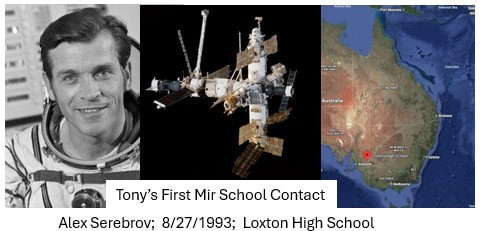
Click here to listen to the contact on YouTube: Loxton First School Contact.
I also did quite a few telebridge contacts for Andy Thomas to speak to his father, Adrian. One contact in particular was very personal and very memorable. We had a pass that was about 88 degrees inclination that passed right over Adelaide, and it was to take place about eight or nine o’clock at night. I teed up with Andy as usual, but what he didn’t know at the time was I took a portable antenna down—a little five element Yagi—and set it up in Adrian’s front garden with a little handheld radio.
Adrian was outside on a beautiful clear night and he could see Mir passing over. And he was excited, talking to his son. He said, “I can see you son. I can see you son.” And it went right over. You see we had been doing telebridges from JSC most weeks, but actually seeing Andy fly over and talking to him at the same time was unreal for Adrian. He had tears in his eyes after that pass.
Another example. During Andy’s last days of the Mir mission, he described to me during a pass the view of the Shuttle coming up and how it just looked like a little pinpoint of light that got bigger and bigger and bigger. And then he said that he had better go and help other guys get prepared for the docking and that he might catch up with me in 90 minutes on the next orbit. And he did. Then Andy described opening the hatch and the different smell of air coming in from the Shuttle.
ARISS: Can you tell us about some of your ARISS contacts in the early days of ISS?
Yes. I did my first contact with the ISS on 14 December 2000, just a month or so after the station was commissioned. It was a personal contact between Bill Shepherd and his wife, Beth. Bill, along with cosmonauts Yuri Gidzenko and Sergey Krikalev, were the first crew to live on the ISS for Expedition 1. They were on the ISS from October 31, 2000, to March 21, 2001.
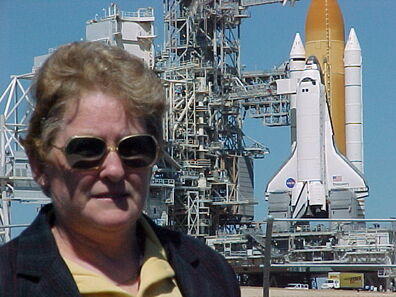
Jill and Discovery prior to the launch of Crew 2 in March 2001
Soon after that contact, Jill and I received a written invitation from NASA to come over to the U.S. in early March 2001 to spend a few days at the Johson Space Center in Houston and then to go over to the Cape to see the launch of STS-102 on March 8. The same shuttle was to be a taxi to bring Bill Shepherd home from the ISS as well. Andy Thomas was set to be a mission specialist on STS-102 and his father Adrian would be at the Kennedy Space Center for the launch. Well, that trip was probably one of the biggest thrills we ever had.
They took us to the launch pad when they were fueling the shuttle, and it surprised me, because they let us off there, and we could have literally thrown stones at the shuttle on the launch pad we were so close. So the next morning, a NASA bus picked us up from our motel about five am. When we got there, we were given a little badge to wear on our lapel to say that we were family and friends. We went to breakfast in the Vehicle Assembly Building, and then we sat down on the bleachers there, because Pad 39b was the launch pad. They had an astronaut explaining things to us. We were about 3-4 kilometers away, which was as close as anyone got to the launch, apart from the emergency crews.
There was a big clock standing in front of us, counting down…20,19,18, and everyone was counting out aloud. It was a great launch and got some terrific photos of it. We could even see the booster rockets separate and come down. And that was, yeah, the noise, of course, came to us after four or five seconds later. When we heard it, it was like a chill all down the back of your spine.
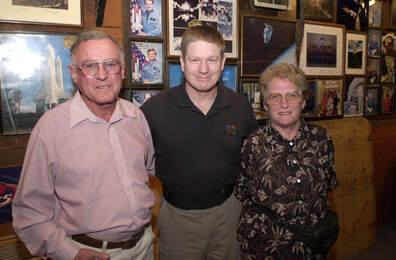
Jill and Discovery prior to the launch of Crew 2 in March 2001
We also had an invitation to see Discovery come back home to the Cape with Bill Shepherd (“Shep”) onboard, but it was scheduled for the middle of the night, so we drove back to Houston. Once the crew returned to the Cape and then on to Houston, there was a reception for Shep and the two cosmonauts at Ellington Airport. We had seats in the front where the two Russians and Shep were on the dais telling their stories. Andy recognized us and began waving.
The next day we went out with Shep to the famous Outpost Tavern at Ellington Field. He gave me his mission hat, which we worked out had done 93 million kilometers in orbit…I still have it.
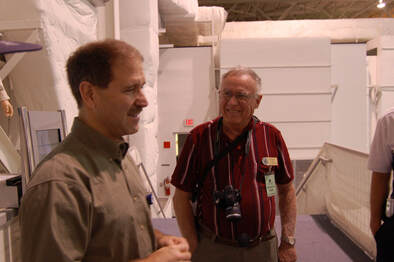
Tony and astronaut John Grunsfeld at the JSC Neutral Buoyancy Tank
As an aside, I took five other hams to JSC again in 2008. It was there that Bill McArthur (KC5ACR), who I first worked when he flew on Columbia in 1993, and Nick Lance (KC5KBO) insisted that they show us around the Center, including the Neutral Buoyancy tank. By coincidence, I met astronaut John Grunsfeld (KC5ATF) at the tank as he was practicing for his mission to service the Hubble Space Telescope (Servicing Mission 5 in May 2009).
I also did a lot of ARISS contacts with Jim Voss, and quite a few with Susan Helms and five or six contacts for Dennis Tito, who was the first private citizen to visit the ISS. Tito wanted to talk to his family and we ultimately got a letter saying that he could use the Russian side. I made five or six contacts for Dennis, to his uncle, his daughter in New Zealand, and others. Afterward, Dennis wrote me a very nice letter, thanking me for all the work I did so that he could speak to his family and friends.
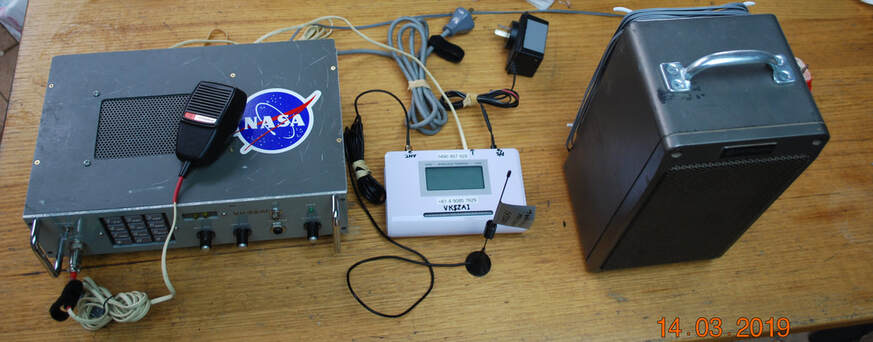
School telebridge setup
ARISS: Aside from personal contacts, how many school contacts did you make during your time with ARISS and before?
As I said earlier, my first school contact took place in August 1993, Alex Serebrov on Mir and the Loxton high school in South Australia. This was one of several Mir contacts I made with schools in the 1990s. Once the ISS became operational in 2000, we began ARISS school contacts in earnest, starting with a link between the ISS and Woodford County middle school in Versailles, Kentucky, on April 9, 2001. From 2001 to my retirement in 2022, I made more than 50 international contacts and more than 75 contacts with Australian educational communities. That’s about 10% of the 1,500 contacts overall that ARISS made over the same time period.
My biggest link-up was in 2019 for the Australian Scout jamboree that was held at a racing track in a rural area. We had just over 10,000 scouts there for the week and 1,000 scout leaders. They wanted me to link to astronaut Mike Fossum back in Houston. I patched him through for 15 minutes to the four or five stages they had set up. There were no phones or anything out there so we had to link into a mobile network. They ended up having a great chat with Mike.
ARISS: Based on all those contacts, what do you see as the importance of ARISS as a STEM outreach tool?
Well, we had feedback from so many people at the schools—teachers, parents, letters from kids—and really just to see the expression on kids’ faces was priceless. I know there are numerous ones that changed their studies in primary school as a result of the contacts. The best part was the excitement on their faces and how they were so keen to talk to an astronaut. To me it’s a great thing, especially with primary school kids who are going to go to high school in the next, next year or two. They are so excited when you explain to them how they might have careers in space. I used to have a bit of a chat with them, probably before and after the contact, if I was at the school in person. I said, you know, there’s only a few people in the world who have become astronauts and flown, but I said there are equally exciting jobs in engineering, electronics, mechanical engineering, and ground crew. I said if you study hard at mathematics and everything and follow that through to university, you could possibly get a job over there [at NASA] one day.
ARISS: Tell us about your Order of Australia award.
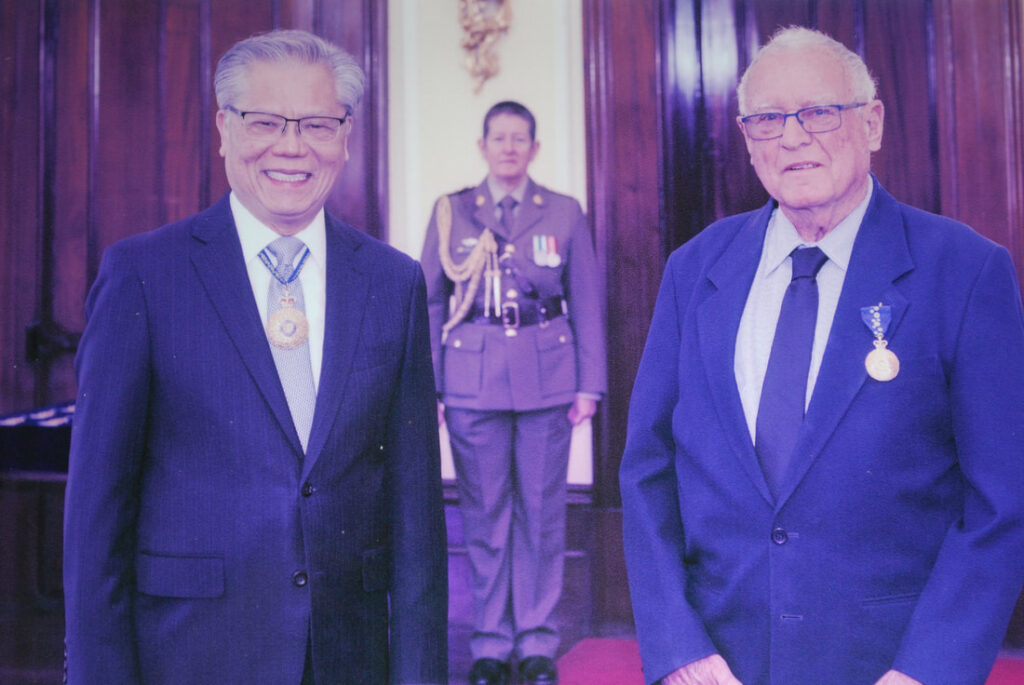
Tony with Governor of South Australia, Hieu Van Le, on being inducted as a Member of the Order of Australia—November 2020
That award is my pride and joy! I was inducted as a Member of the Order of Australia in November 2020 for my service to amateur radio, particularly for satellite and space communications. It was a great honor to receive it. There are three medals associated with the Order: The largest medal is to be worn in the daytime to official ceremonies; the smaller version that is worn in the evening for official dinners and similar events, and a small one with a jewel in the center that is used for everyday purposes so that the honoree can be recognized in the street as a member of the Order.
[Accompanying the award was a long list of Tony’s achievements in amateur radio]
ARISS – Amateur Radio on International Space Station (ISS)
- National coordinator for Australia, one of 10 official ARISS VHF-UHF telebridge stations to the ISS, and a HamTV ground station, current.
- Engineering Support and ARISS Technical Mentor.
- Recent Radio Linkup, retired Colonel and Astronaut Michael Fossum, Scout Leader, Australian Scout Jamboree, 2019, and Ashbury College in Ottawa, Canada with Astronaut David St. Jacques, 2019.
- Communications Support, Australian Astronaut Andy Thomas (VK5JAT), on MIR space station.
- Founding Member, since 1996.
- First school radio linkup, Mir Space Station, 1993.
AMSAT VK – The Radio Amateur Satellite Corporation
- Operator/member (VK5ZAI), current
Australia Volunteer Coast Guard Association
- Coast Guard Kingston/Robe (VMR555), since 2003.
Kingston District Council
- Councillor, 2010-2014.
Kingston Combined Probus Club
- Foundation member, since 2004.
- President and Vice President, three occasions.
Tatiara Community Broadcasters (5TCB)
- Life Member, since 2016.
- Co-Founder and Board Member, 1970s-1988.
Awards and and recognition include:
- 20-year Sustained Service Award, ARISS, 2014.
- SES Meritorious Service Award, 2014.
- Outstanding Contribution to Human Spaceflight, AMSAT, 2014.
- Engineering Award, Johnson Space Center, USA, 2006.