History
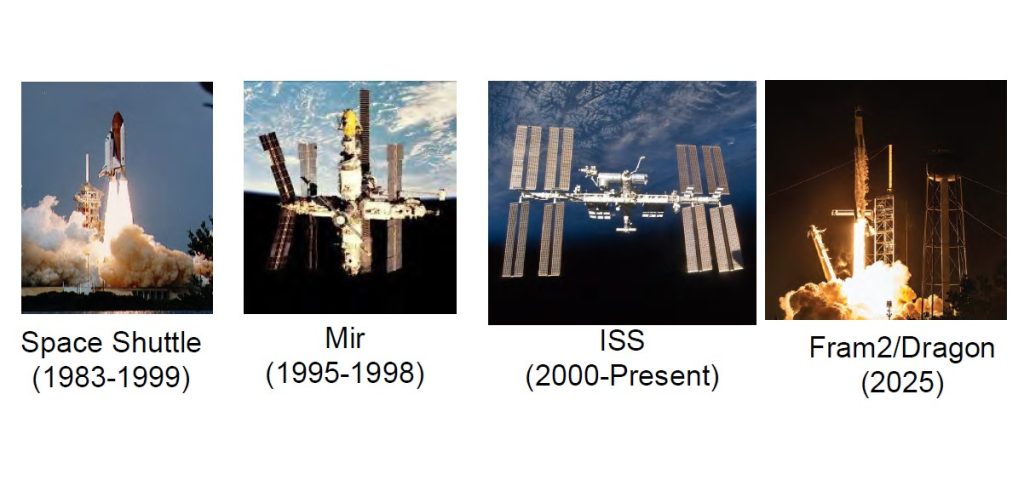
ARISS on human spaceflight vehicles (1983-present)
ARISS, or Amateur Radio on the International Space Station (ISS), was created and is managed by an international consortium of amateur radio organizations and space agencies including National Aeronautics and Space Administration (NASA) in the USA, Rosaviakosmos in Russia, Canadian Space Agency (CSA) in Canada, Japan Aeronautics Exploration Space Agency (JAXA) in Japan and European Space Agency (ESA) in Europe. The goal was (and remains) to build and operate Amateur Radio equipment for space to be used for educational purposes.
The international cast of amateur radio organizations provide the equipment and operational support to enable direct communication between crew on the ISS and students around the world. Hundreds of amateur radio operators around the world work behind the scenes to make these educational experiences possible.
The Beginning: Space Shuttle
Amateur radio was a regular payload on Shuttle missions beginning with the STS-9 mission in November 1983, when Owen Garriott, W5LFL, carried a hand-held ham radio aboard Space Shuttle Columbia. The Shuttle Amateur Radio Experiment (SAREX) provided students with the unique opportunity to talk directly with astronauts in the Shuttle while they orbited the Earth traveling 17,000 miles per hour. With the help of Amateur Radio operators, students could attempt to contact the astronauts flying on a SAREX mission through voice, packet (computer) radio, or television, depending on which equipment configuration the Shuttle takes into space. Through voice communication students asked questions about the experiments being conducted on the mission and what it is like living in space. When the astronauts were asleep, a robot computer Amateur Radio station aboard the Shuttle made contact with hundreds of hams around the world. Students could track the Shuttle’s orbit using computer software, “eavesdrop” on Shuttle communications, and listen to NASA mission commentary and bulletins about astronaut-planned transmissions.
In 1996, delegates from major national Amateur Radio organizations, such as ARRL, and from national Amateur Radio satellite organizations, such as AMSAT, in the eight nations involved with the international space station, signed a Memorandum of Understanding to form ARISS.
NASA and the Russian space organization Energia have signed agreements that spell out where the physical location of the Amateur Radio equipment will be set up on the ISS. A technical team was officially established by NASA to serve as the interface to support hardware development, crew training and on-orbit operations.
In the United States, the ARRL and AMSAT provide leadership and consultation. AMSAT donates and builds hardware as well as ensuring all safety and qualification tests required by the space agencies are successfully completed so the equipment can fly. The Russians provided ports for antennas that were mounted on the station’s Zvezda Service Module — the space station unit that provides living quarters for the astronauts and cosmonauts.
United States and Russian teams have trained astronauts and cosmonauts to operate the equipment. The Italian team has designed and built antennas. The German team has built sophisticated repeater stations that will allow crews to make recorded reports on their daily activities and permit hams on Earth better contacts with men and women aboard the station. The Italian team has designed and built antennas, and most recently conceived and engineered the new HamTV system in process of deployment.
The sponsoring agencies have stated that they consider access to a ham radio system a psychological support for the crews, providing them with a way to be connected and to do public outreach while they are detached in space for many weeks at a time. In addition, Amateur Radio is a platform that allows astronauts, to quote NASA, “to offer an educational resource to students as only NASA can.” Amateur Radio provides a contingency communications network for the ISS as well.
For more about the early deployment of ham radio in space and with the predecessor SAREX program, read the story as told by Frank Bauer, KA3HDO, for the 30th anniversary celebration of amateur radio on human spaceflight missions.
In addition to the ISS, ARISS has flown amateur radio and made contacts from a number of crewed SpaceX Dragon missions as well as other special missions, including SuitSat-1. We are also exploring with NASA the possibility of having ARISS amateur radio equipment on the moon!
ARISS Structure
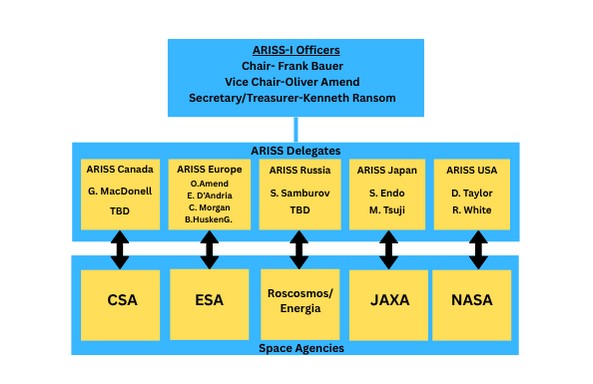
ARISS is an international working group, consisting of delegations from 15 countries including several countries in Europe as well as Japan, Russia, Canada, and the USA. The organization is run almost entirely by volunteers from the national amateur radio organizations (e.g. the American Radio Relay League or ARRL in the U.S.) and the international AMSAT (Radio Amateur Satellite Corporation) organizations (e.g. AMSAT-NA in North America). Since ARISS is international in scope, the team coordinates locally with their respective space agency – the Canadian Space Agency (CSA), the European Space Agency (ESA), the Japan Aerospace Exploration Agency (JAXA), the Russian Space Agency (Roscosmos) and the National Aeronautics and Space Administration (NASA). Globally, ARISS-International coordinates as a team through working group meetings, teleconferences and electronic mail. ARISS-International consists of five regions (Canada, Europe, Japan, Russia and the U.S.) which parallel the five ISS space agencies. The ARISS-International Board includes the following officers: Chair, Vice-Chair and Secretary/Treasurer. Each region has two voting delegates except Europe, which has four delegates due to the many countries and regional space organizations that comprise Europe. These delegates are chosen from the national amateur radio societies and AMSAT organizations. Delegates are the designated points of contact for each ARISS region. Because parts of the world are not aligned to a specific ARISS region, augmentations to the regions are as follows:
- ARISS-Canada includes the Americas, except USA
- ARISS-Europe includes Africa, Middle East and Northern Asia
- ARISS-Japan includes Asia, Pacific and Australia
- ARISS-Russia
- ARISS-USA
The international team donates approximately $5 million per year of in-kind support to the ISS program, primarily through technical and educational volunteer support to the schools, flight hardware development, and contact operations support. In the U.S., the primary ARISS sponsors are NASA’s Space Communication and Navigation (SCaN) organization and the Center for the Advancement of Science in Space (CASIS). They provide financial support to fund the cost of ARISS operations support in Houston, which permits contact scheduling, crew training and crew ham radio licensing. ARISS-International organization consists of five regions (Canada, Europe, Russia, Japan and the U.S.) paralleling the five ISS space agencies.
International Amateur Radio Union (IARU) societies and Radio Amateur Satellite Corporation (AMSAT) organizations participating in ARISS:
- Europe:
- Belgium: Union Royale Belge Des Amateurs-Emetteurs (UBA), AMSAT-Belgium
- France: Reseau des Emetteurs Francais (REF-Union), AMSAT Francophone
- Germany: Deutscher Amateur Radio Club e. V. (DARC)
- Italy: Associazione Radioamatori Italioni (ARI), AMSAT-Italia
- Netherlands: Vereniging voor Experimenteel Radio Onderzoek in Nederland VERON
- Poland: Polski Związek Krótkofalowców (PZK)
- Portugal: Rede dos Emissores Portugueses (REP)
- Sweden: AMSAT-SM
- Switzerland: Union Schweizerisscher Kurzwellen-Amateure USKA
- United Kingdom: Radio Society of Great Britain RSGB, AMSAT-UK
- Japan: Japan Amateur Radio League (JARL), JAMSAT
- Russia: Soyuz Radioljubitelei Rossii (SRR), AMSAT-RU
- USA: American Radio Relay League (ARRL), AMSAT-NA
Space agencies partnering with ARISS:
- Canada: Canadian Space Agency (CSA)
- Europe: European Space Agency (ESA), including participating members:
- Belgium: Belgian Federal Science Policy Office (BSPO)
- Denmark: Danish National Space Center (DNSC)
- France: Centre national d’études spatiales / National Centre for Space Studies ( CNES)
- Germany: Deutsches Zentrum für Luft- und Raumfahrt (DLR)
- Italy: Agenzia Spaziale Italiana / The Italian Space Agency (ASI)
- Netherlands: Netherlands Space Office (NSO)
- Norway: Norwegian Space Centre (NSC)
- Spain: Centre for the Development of Industrial Technology (CDTI)
- Sweden: Swedish National Space Board (SNSB)
- Switzerland: State Secretariat for Education and Research (SERI)
- United Kingdom: UK Space Agency (UKSA)
- Japan: Japan Aerospace Exploration Agency (JAXA)
- Russia: Roscosmos State Corporation for Space Activities (Roscosmos)
- USA: National Aeronautics and Space Administration (NASA)
ARISS Governance
The ARISS organization is governed by the Terms of Reference adopted by the member societies. ARISS-International consists of the following Board and Delegate members:
ARISS Officers
Chairman: Frank Bauer, KA3HDO
Vice Chairman: Oliver Amend, DG6BCE
Secretary: Kenneth Ransom, N5VHO
ARISS Delegates
CANADA
Glenn MacDonell, Radio Amateurs of Canada (RAC)
TBD, AMSAT-NA
EUROPE
Oliver Amend, DG6BCE, Deutscher Amateur Radio Club e. V. (DARC)
Ciaran Morgan, M0XTD, Radio Society of Great Britain (RSGB)
Emanuele D’Andria, I0ELE, Amateur Radio Satellite Corporation of Italy (AMSAT-Italia)
Bertus Hüsken, PE1KEH, Vereniging voor Experimenteel Radio Onderzoek in Nederland (VERON)
JAPAN
Shizuo Endo, JE1MUI, Japan Amateur Radio League (JARL)
Masanobu Tsuji, JH2PRZ, Amateur Radio Satellite Corporation of Japan (JAMSAT)
RUSSIA
Sergey Samburov, RV3DR, Energia/ Roscosmos State Corporation for Space Activities (Roscosmos)
TBD, Russian Federation
USA
Rosalie White, K1STO, American Radio Relay League (ARRL)
Dave Taylor, W8AAS, Radio Amateur Satellite Corporation – North America (AMSAT-NA)