Artemis
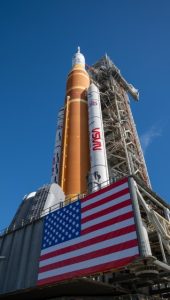 As part of the recent Artemis 1 and Artemis 2 missions, a team of ARISS and AMSAT volunteers used a multinational network of ground station receivers to capture the Orion capsule’s one-way S-band communications with mission control as a secondary means of tracking the spacecraft.
While NASA’s Space Communications and Navigation (SCaN) program is depending on the Near Space and Deep Space Network for primary tracking of the Orion during its 10-day mission around the moon and back, it has also asked a worldwide network of individuals and groups (including an ARISS and AMSAT consortium) to provide an independent source of tracking data using the radio waves generated by normal communications.
The concept works. For Artemis 1, an uncrewed launch into low-Earth orbit in 2022, 10 individuals successfully tracked Orion throughout its mission. Based on lessons learned from that experience, SCaN put in place data standards for passive tracking data for Artemis 2 and future missions.
ARISS and AMSAT are teamed up under the auspices of the AREx (Amateur Radio Exploration) Ground Station Consortium. AREx is a joint ARISS and AMSAT international effort to develop and operate amateur radio systems for deep space, starting at the moon and later to Mars. The team will provide one-way doppler tracking of the S-band signals from space, recording the data and delivering it to SCaN in the proper format.
The AREx worldwide consortium includes teams in the United States (University of Southern California, and Dayton, Ohio); the UK (Goonhilly); Germany, and Poland. Other AREx team members who supported the Artemis I initiative are also participating separately.