Sponsors
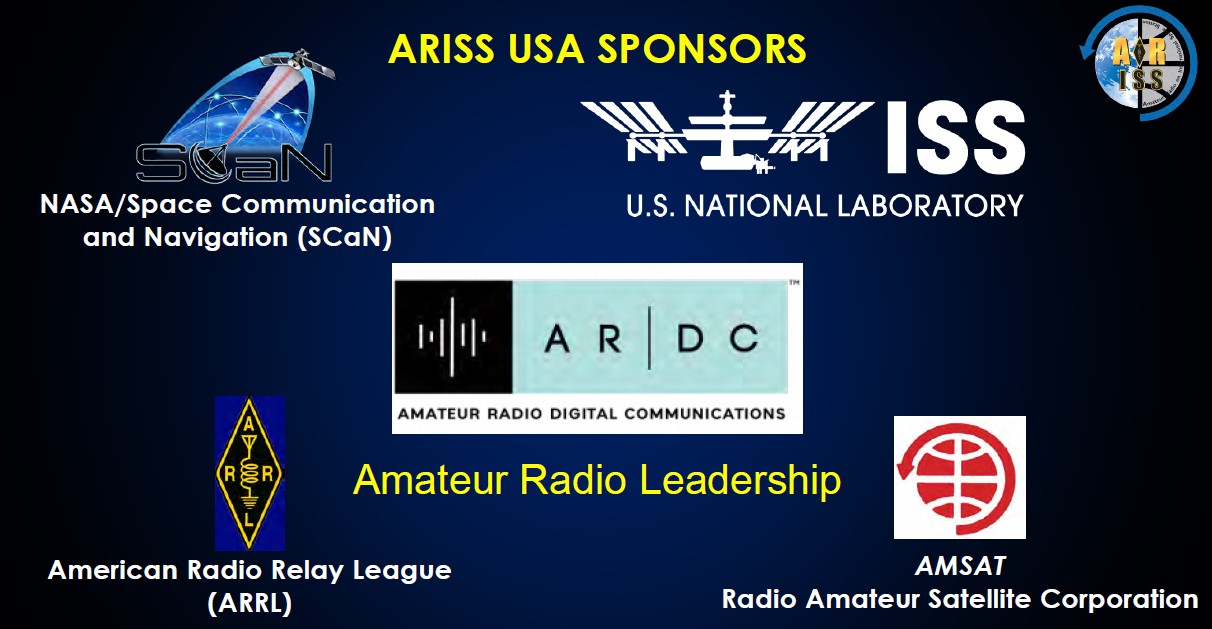
ARISS appreciates our partners and sponsors: (NEED CLICKAGE LOGOS FOR ALL)
- National Amateur Radio Societies
- AMSAT Organizations in Canada, Europe, Japan, Russia and the USA
Amateur Radio on the International Space Station (ARISS) receives funding from and uses resources of the International Space Station U.S. National Laboratory. ARISS is a member of the Space Station Explorers consortium.
ARISS is a cooperative venture of international amateur radio societies and the space agencies that support the International Space Station (ISS). In the United States, sponsors are the Radio Amateur Satellite Corporation (AMSAT), the American Radio Relay League (ARRL), the International Space Station U.S. National Laboratory and National Aeronautics and Space Administration (NASA). The primary goal of ARISS is to promote exploration of science, technology, engineering, and mathematics (STEM) topics by organizing scheduled contacts via amateur radio between crew members aboard the ISS and students in classrooms or public forms. Before and during these radio contacts, students, educators, parents, and communities learn about space, space technologies, and amateur radio.
About the International Space Station (ISS) U.S. National Laboratory:
In 2005, Congress designated the U.S. portion of the ISS as the nation’s newest national laboratory to optimize its use for improving quality of life on Earth, promoting collaboration among diverse users, and advancing science, technology, engineering, and mathematics (STEM) education. The ISS U.S. National Laboratory manages a portfolio of both basic and applied research projects to support the transition of low Earth orbit to a robust space economy. A fundamental component of the ISS National Lab mission is to make the unique properties of the low Earth orbit environment available for use to non-NASA U.S. government agencies, academic institutions, and the private sector. Through management of a comprehensive and diverse research portfolio, the ISS National Lab is driving innovative science that can benefit life on Earth and demonstrate the value of space-based research to the American public.
Space Station Explorers is a consortium of organizations that use the power and appeal of the International Space Station to engage students. Consortium members develop and deliver high-quality educational programs that feature science, technology, engineering and mathematics (STEM) concepts and skills. This includes the opportunity for students to design, build, launch and/or operate their own experiments on the ISS. The consortium works with educators, learners and explorers of all ages.