International Space Station
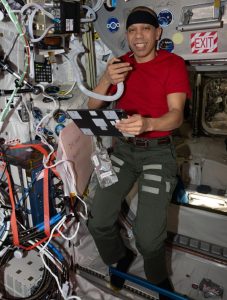 ARISS owns—and developed—most of the amateur radio hardware on the ISS and we are the principal investigator for the ISS Ham Radio payload, which was the first operational payload aboard the space station starting on November 13, 2000. Crew members have been making ham radio contacts and talking to schools from the space station since the first crews inhabited the station.
There are two ham radio systems about the ISS: One in the Columbus Module, a USOS Segment Kenwood D710GA (call sign NA1SS), and one in the Russia Segment, a Kenwood D710GA (call sign RS0ISS).
NA1SS is primarily used for voice USOS contacts and events and its default operations are as a voice repeater/voice relay. The system also has video capability through an RF video signal, which we call HamTV. Equipment for HamTV includes a Canon XF705 camera that sends data to an HDMI converter.
RS0SS is primarily used for voice Russian contacts and events. It’s default operations are for packet/APRS/digital text messaging. It also supports Slow Scan TV (SSTV) operations.
Both radio systems can be used to transmit data/telemetry and both are operational 24/7/365
Antenna locations: On the Russian Segment exterior there are four antenna systems on the Service Module: 3 VHF/UHF, 4 L/S Band, 1 HF, LS band (ham radio and experiments). The Columbus module exterior has 1 VHF/UHF antenna (Ham radio, experiments) and 2 L/S band antennas (Ham video, experiments).