ARISS Value Proposition
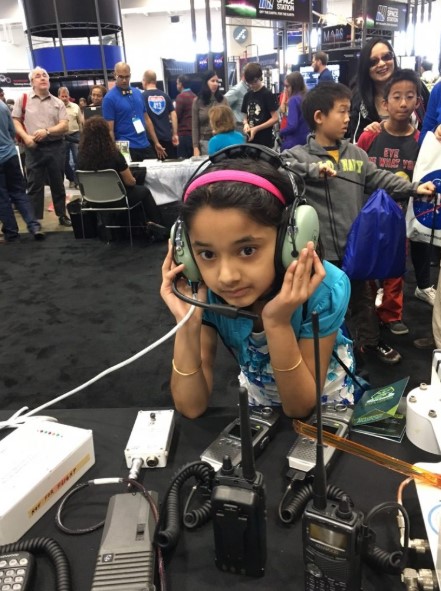 ARISS provides significant primary and auxiliary benefits to spaceflight providers, including educational outreach and workforce development, an independent, platform-agnostic backup communications capability with global interoperability, psychological support for crews qualified to operate the equipment, and as a low-cost radio technology experimentation capability. ARISS supplies flight-certified hardware, pre-launch integration support and full engineering support.
Educational Outreach and Workforce Development
- Demonstrated link between youth participation in contacts and careers in aerospace
- Proven outreach metrics: On the ISS, ARISS engages more than 40,000 youth and more than 150,000 members of the public each year through 60-100 scheduled radio contacts per year
Backup Communications
- ISS Ham Radio systems are independent of space station’s communications systems
- ARISS provides a resilient contingency path for communications in the event of a primary system failure
- In fact, ham radio was the primary communications link after a systems failure during a MIR mission until power and attitude were restored
- Established ARISS ground stations can be activated to facilitate contact between the space station and Mission Control
- ARISS ground stations that serve as telebridge stations for school contacts can also provide backup comms support.
Psychological Support for Crewmembers
- ISS Ham Radio was first used as a tool for astronaut psych support
- Astronauts find educational outreach to inspire students via ham radio very gratifying
- Besides scheduled events, astronauts also have the fun opportunity to talk directly with hams on the ground
- Hams are listening for the NA1SS (call sign for the ISS) voice repeater from all over the world
Examples of Radio Frequency Technology Experiments
ISS Ham Video (Ham TV)
- Transmits an mpeg2 video test signal at 2.395 GHz using DVB-S protocol
- Provides the option for youth to see and hear the astronaut during their communications via ham radio
- Ham radio operators on the ground use default ops signal for testing and experimentation
- Content is available for public dissemination
Slow Scan Television (SSTV)—Picture downlinks
- Analog transmission of color or B&W images (like facsimile technology)
- Engages ham enthusiasts, students, and educators; Gallery participation: >238K images, 45K customers, 25% youth, 25% educators
ISS Ham Video (Ham TV)
- Transmits an mpeg2 video test signal at 2.395 GHz using DVB-S protocol
- Option for youth to see and hear the astronaut during their communications via ham radio
- Ham radio operators on the ground use default ops signal for testing and experimentation
NAVCOM Experiment
- Installation and deployment in Spring of 2025
- Objective: Test new PNT receiver algorithms on-board ISS with five ground-based PNT pseudosignals to demonstrate the feasibility of S-Band lunar PNT operations
- Used Qascom GNSS* receiver upgraded to support lunar PNT** S-Band signals. First on-orbit data demonstration of this type.
- Partnership between NASA, Italian Space Agency, Qascom, and ARISS
- On-board hardware and software: Qascom receiver; Software-Designed Radio (SDR) technology coupled with algorithms to support S-band lunar PNT solutions; ARISS S-band antenna system
- Successfully received and processed navigation signals simultaneously from five ground stations to compute real time position, nav and time data
- Results lay a firm foundation for future lunar PNT architectures supporting NASA’s, ESA’s, and JAXA’s lunar PNT programs while sharing strong technical synergies with LuGRE on Firefly’s Blue Ghost mission in 2025
*Global Navigation Satellite System
**Positioning, Navigation, and Timing