
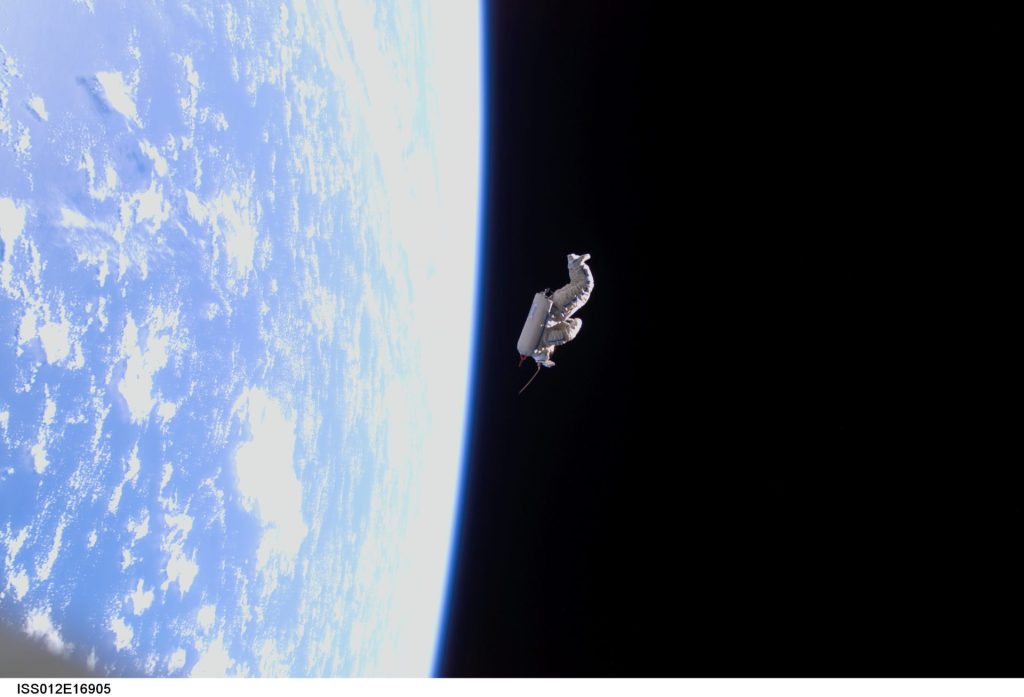
SuitSat-1 after deployment from the ISS—February 3, 2006
Twenty years ago today, spacewalking International Space Station (ISS) cosmonaut Valery Tokarev and astronaut Bill McArthur hand-launched the largest “object” ever to be cast into open space from the ISS—the amateur radio experiment called SuitSat-1, or Radioskaf in Russian.
While the ham radio satellite transmitted audio and SSTV for only two weeks and remained in orbit only seven months before reentering the atmosphere, the achievement expanded the envelope for the possible uses of ham radio in space while also opening the door for the ISS-launched “cubesat” movement. Mentions in the press included articles in Popular Science and Reader’s Digest.
Suitsat-1 also spurred the creative juices of filmmakers who produced at least two spooky short films, SuitSat in 2018 and Decommissioned in 2021.
The fact that SuitSat-1 became a reality at all is a tribute to the can-do attitude of ARISS and a global assembly of ham enthusiasts. The team—ARISS, Roscosmos, the Amateur Radio Relay League (ARRL) and the Radio Amateur Satellite Corporation (AMSAT)—had just three weeks in the early 2005 to design, build and deliver the flight hardware that would be integrated into and onto the SuitSat “bus”—a decommissioned Russian Orlon spacesuit.
Even more pressing was the challenge of satisfactorily addressing all ISS safety concerns before SuitSat-1 could be flown to the ISS by the Expedition 11 crew in April 2005.
Key ARISS contributors were our Russian counterparts, led by Sergei Samburov (RV3DR), center in the picture above. Samburov conceived the idea and helped with the testing and training required for the Expedition 11 crew to deliver SuitSat-1 hardware to the ISS, and the Expedition 12 crew to deploy the amateur radio satellite.
In the US, Lou McFadin (W5DID) and Frank Bauer (KA3HDO) led the team that built and tested the hardware in a very short timeframe. Along with Sergey, Lou and Frank, dozens of other ARISS volunteers around stepped up to bring together not only the hardware and training, but the educational outreach for schools to participate.
Once on orbit, cosmonaut Valery Tokarev and astronaut Bill McArthur of the Expedition 12 crew assembled the SuitSat-1, and during an extra vehicular activity, carefully hand-launched the ham radio satellite into its own orbit away and below the ISS. Shortly afterward, SuitSat-1 began transmitting a five-minute message of telemetry, greetings from an international cast of students, and an SSTV image. This YouTube video discusses the project and includes a recording of the five-minute message.
While hams were able to receive the SuitSat-1 message, the signal strength was lower than expected, most likely due to a cracked antenna and the spin rate of the suit. Regardless, SuitSat-1 was a major success for ARISS and ham radio enthusiasts worldwide, with almost 10 million hits on a SuitSat website in the month of February 2006.
Fast forward 20 years and we can see the foundational effects of the experience as we now move beyond ISS to ARISS on commercial space missions and moon and mars exploration.
Long live SuitSat-1!